
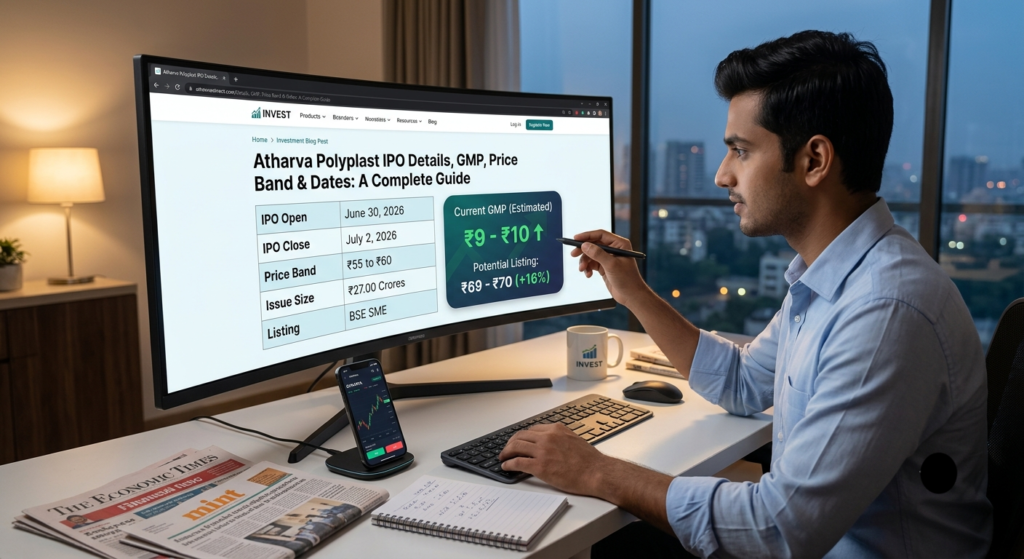
Atharva Polyplast Limited is gearing up to launch its SME IPO on the BSE SME platform. The company, a prominent manufacturer of precision-engineered plastic components, is looking to raise ₹27 Crores entirely through a fresh issue of shares.
If you are tracking the SME IPO market, here is everything you need to know about the Atharva Polyplast IPO, from its current Grey Market Premium (GMP) and financial health to important dates and investment minimums.
Atharva Polyplast IPO Key Details
The issue is a 100% book-built offer with no Offer for Sale (OFS) component. Here is a quick glance at the core offering:
| Parameter | Details |
| IPO Open Date | June 30, 2026 |
| IPO Close Date | July 2, 2026 |
| Issue Size | ₹27.00 Crores (45,00,000 shares) |
| Face Value | ₹10 per share |
| Price Band | ₹55 to ₹60 per share |
| Minimum Lot Size | 2,000 Shares |
| Retail Minimum Investment | ₹2,40,000 (4,000 shares / 2 Lots) |
| Listing Exchange | BSE SME |
| Registrar | MUFG Intime India Pvt. Ltd. |
| Lead Manager | Horizon Management Pvt. Ltd. |
Note for Retail Investors: While the lot size is 2,000 shares, the minimum investment requirement for retail individuals is set at 2 lots (4,000 shares), meaning a minimum outlay of ₹2.40 lakh at the upper price band.
Important IPO Dates & Timelines
Ensure you track these dates so you don’t miss the application or allotment window:
- IPO Opens: Tuesday, June 30, 2026
- IPO Closes: Thursday, July 2, 2026
- Basis of Allotment: Friday, July 3, 2026
- Initiation of Refunds: Monday, July 6, 2026
- Credit of Shares to Demat: Monday, July 6, 2026
- Tentative Listing Date: Tuesday, July 7, 2026
Current GMP & Expected Listing Price
The Grey Market Premium (GMP) is a strong indicator of an IPO’s unofficial demand before it hits the exchanges.
- Current GMP: ₹9 to ₹10 (As of late June 2026)
- Estimated Listing Price: ₹69 to ₹70
- Expected Listing Premium: ~15% to 16.6%
Disclaimer: GMP is highly volatile and unofficial. It should not be the sole metric used to make investment decisions.
Company Overview: What Does Atharva Polyplast Do?
Founded in 2014, Atharva Polyplast Limited specializes in manufacturing precision plastic components using injection moulding. Operating out of a sprawling facility in Khandala, Maharashtra, they process materials like polypropylene (PP), ABS, and high-density polyethylene (HDPE).
The company caters primarily to Original Equipment Manufacturers (OEMs) and Tier-1 suppliers across various industries, including:
- Automotive assemblies
- Home appliances
- Office furniture
- Industrial engineering
They provide end-to-end support, moving from mould design and prototyping to final production and quality assurance.
Financial Highlights
Atharva Polyplast has demonstrated steady revenue generation and a sharp increase in profitability over the last few fiscal years.
| Metric (in ₹ Crores) | FY 2025 | FY 2024 | FY 2023 |
| Total Revenue | 47.54 | 41.49 | 45.30 |
| Profit After Tax (PAT) | 5.29 | 2.00 | 0.71 |
| Net Worth | 13.01 | 7.72 | 5.72 |
| Total Borrowings | 6.51 | 13.59 | 16.16 |
The company successfully reduced its debt burden significantly from FY23 to FY25 while heavily boosting its PAT.
Objectives of the Issue
The company plans to utilize the ₹27 crore net proceeds for the following purposes:
- Capital Expenditure: Purchasing new machinery to expand manufacturing capabilities.
- Debt Repayment: Full or partial repayment of outstanding borrowings to improve the balance sheet.
- Working Capital: Meeting day-to-day operational expenses.
- General Corporate Purposes.
Strengths vs. Risks
Key Strengths:
- Integrated manufacturing capabilities offering end-to-end solutions.
- Diversified client base across automotive, appliances, and furniture sectors.
- Strong recent financial turnaround with improving profit margins and reduced debt.
Potential Risks:
- Customer Concentration: A significant portion of revenue relies on a few key OEM clients.
- Single Facility: All manufacturing operations are consolidated in one facility in Maharashtra, leaving them vulnerable to localized disruptions.
- Raw Material Volatility: Dependence on polymer-based materials means their margins are sensitive to fluctuating crude oil and plastic prices.
What are the key differences, risks, and benefits of investing in an SME IPO compared to a mainboard IPO?
Investing in a Small and Medium Enterprise (SME) IPO is fundamentally different from investing in a traditional Mainboard IPO. While Mainboard IPOs feature household names like Hyundai India or Swiggy, SME IPOs represent early-stage, smaller companies seeking growth capital.
The differences come down to scale, regulatory stringency, and risk vs. reward profiles.
1. Key Differences at a Glance
| Feature | SME IPO | Mainboard IPO |
| Company Size | Small to medium (Post-issue paid-up capital less than ₹25 Crores) | Large companies (Post-issue paid-up capital greater than ₹25 Crores) |
| Minimum Ticket Size | High: Typically ₹1,00,000 to ₹1,40,000+ per lot | Low: Typically ₹14,000 to ₹15,000 per lot |
| Trading Lot Size | You must buy/sell in defined lots (e.g., 1,000 or 2,000 shares) | Once listed, you can trade even a single share |
| Market Maker | Compulsory market makers to provide liquidity for 3 years | No market maker required |
| Vetting Authority | Stock Exchanges (BSE SME / NSE Emerge) check the prospectus | SEBI directly reviews and vets the prospectus |
2. The Benefits of SME IPOs
- Multibagger Potential: Because these companies are entering the market at an early stage, they have significantly more room to grow. A micro-cap company can double its revenue much faster than a massive conglomerate.
- High Listing Gains: Due to massive retail and HNI (High Net Worth Individual) enthusiasm, popular SME IPOs regularly list at a 50% to 100%+ premium over their issue price.
- Institutional Discovery: Successful SMEs eventually transition to the Mainboard exchange once they clear capital thresholds, often unlocking massive valuation jumps when large institutional mutual funds are finally allowed to buy them.
3. The Significant Risks
While the rewards can be massive, the risks associated with SME IPOs are disproportionately high compared to Mainboard IPOs:
- Severe Liquidity Risk (The “Locked In” Problem): This is the biggest hurdle. Because you cannot trade single shares, you must sell your shares in exact lot sizes. If a stock hits a lower circuit (nobody is buying), you can be completely stuck with a position worth over ₹1.5 lakh that you cannot sell.
- High Volatility & Manipulation: Because the market cap is small and fewer shares are available, SME stock prices can be heavily impacted by a small number of traders or “operator” activity, leading to wild, unpredictable price swings.
- Lower Regulatory Scrutiny: SEBI does not thoroughly vet SME IPO prospectuses; the responsibility lies with the respective exchange and the Lead Manager. This historically means looser corporate governance checks compared to a Mainboard draft red herring prospectus (DRHP).
- Business Vulnerability: Smaller companies are highly vulnerable to macro shocks. Losing a single major client, a sudden shift in raw material pricing, or a regulatory change can severely cripple an SME’s balance sheet overnight.
The Investor Takeaway: Mainboard IPOs are suited for general retail investors looking for steady, stable growth with immediate liquidity. SME IPOs function closer to high-stakes venture capital — they are best reserved for experienced investors who have the surplus capital to take on high risk and tolerate being locked into a position.